FUZEON (T-20)
ATAC's Fuzeon FAQ (April 2003) now available for download!
ATAC Drug Development Committee sends questions to Roche Labs. See Roche page.
Groups offer up news releases, statements, policy/position papers, and at least one street action...
NEW ENGLAND JOURNAL OF MEDICINE ARTICLE
FUZEON FREQUENTLY
ASKED QUESTIONS FOR THE HIV COMMUNITY
(FAQ prepared by the ATAC
Drug Development Committee)
This FAQ is intended to answer basic questions that have arisen about Fuzeon. Word Document PDF Document
Q. What is Fuzeon?
A. Fuzeon is an anti-HIV drug from a new class that fights HIV in a different
way than other AIDS drugs you may have taken before. When HIV enters the
body, it seeks out important immune cells to invade. One target is the
CD4 T cell, where HIV attaches, fuses with the outer coating of the cell,
and inserts itself into the cell. All of these steps work like a series
of locks and keys that get HIV into the cell so it can take it over and
make copies of itself, kind of like a copy machine. If one lock or key
is out of place or damaged, HIV cannot attach and enter the cell. Fuzeon
stops one of those keys from working and prevents HIV from fusing with
the human cell.
Q. Who is Fuzeon for?
A. Fuzeon has been approved by the FDA for use in combination with other
anti-HIV drugs in treatment-experienced patients unable to fully suppress
HIV on their current regimens. For most people, this means that Fuzeon
is an option of last resort-if you're resistant to a lot of HIV medications,
Fuzeon might be useful in constructing a new regimen, especially if you
have one or two other drugs you can take that you're not resistant to.
Your doctor will probably use resistance tests to select which drugs may
have the best chance of still fighting the virus. Studies show that Fuzeon
will work best for people who take it with two other drugs that they have
never taken before. In general, people who aren't resistant to a lot of
drugs will prefer HIV medications that are easier to take because Fuzeon
must be taken as an injection (see next question).
Q. How do you use Fuzeon?
A. Fuzeon is not a pill but a powder that has to be mixed with sterile water
(taking up to 30 minutes to dissolve). The solution is then injected with
a needle into the upper layer of skin (usually in the abdomen, upper legs,
or upper arms) twice a day. This process takes a while to learn and to
get used to, but over time, people adjust to it in a similar way as people
with diabetes learn to self-inject insulin. Your doctor, pharmacist, and
other health care providers can teach and assist you with how to do the
injections properly.
Q. Aren't needles tricky? Does the injection hurt?
A. Everyone reacts to needle injections differently. The needle that is used
is very small but it may hurt a little going in, like a pin-prick. When the
fluid is pushed into the skin, it also can cause some pain. In most people
Fuzeon causes a stinging reaction that can cause bumps, itching, redness,
and pain. The reactions usually go away, but sometimes can last a few weeks.
You have to alternate where you inject yourself to avoid the bumps. Some
people who have been using Fuzeon for a long time get hardened layers of
skin that limit the sites where they can inject.
Q. What if I have a fear of needles?
A. Fuzeon is not for everyone, so it is your choice to decide whether you
want to take it and whether you can tolerate it. Some people get used to
the injections. Others simply choose another therapy, if available, or
choose to wait for a new therapy to come along that is easier to take.
Q. How do I get Fuzeon?
A. Have a talk with your doctor to decide if Fuzeon is right for you. If
so, the process required is different than what happens with the typical
prescription and initially most local pharmacies will not carry the drug.
First, your doctor should call 1-866-694-6670 or go to the website www.fuzeon.com
to get a "Prescription Enrollment Form." The doctor fills out
and then faxes the form to the "Fuzeon Progressive Distribution Program" at
1-877-428-9520. They will check if you have insurance or coverage by a
state AIDS Drug Assistance Program (ADAP) to pay for the drug. You can
find out more information about ADAPs, including a listing state-by-state,
at www.atdn.org/access/adap. Because Fuzeon is the most expensive AIDS
drug ever ($25,000 per year), some payment plans and prescription drug
programs may not pay for it. Once your method of payment is verified, your
prescription will be filled. The drug either will be sent to you or will
be available for you to pick up at your doctor's office or a Statscript
pharmacy in your area.
Q. What if my state's ADAP or Medicaid will not add Fuzeon to its list of
AIDS drugs?
A. It depends on your state. ATAC is working with Roche, the company that
makes Fuzeon, to ensure that anyone who cannot construct a viable treatment
regimen and needs Fuzeon will be able to get it regardless of coverage. Roche
has promised to establish a Patient Assistance Program and to find a method
of payment for you regardless if you have insurance or not.
Q. This all sounds very complicated! Doesn't it?
A. Yes, it is complicated. Fuzeon is a unique drug, and you will need lots
of support to get access to it and to learn how to use it correctly. Because
Fuzeon is an injectable drug with unpleasant injection site reactions and
is not carried by all insurers, including ADAP and Medicaid, Fuzeon will
not be the best choice for everyone. There are seventeen approved drugs
for HIV and three more may be added this year. There are new protease inhibitors
in expanded access (available from drug companies even though they are
not yet approved by the FDA) that also work against drug-resistant virus.
Also, there are other potential therapies in clinical trials. But for those
who have absolutely no other choice, Fuzeon may be the drug of last resort.
ROCHE ANNOUNCES
FDA APPROVAL, DISTRIBUTOR,
PRICING AND
A "PROGRESSIVE DISTRIBUTION PROGRAM"
ATAC REACTION:
The
ATAC Drug Development Committee issued the following statement,
also available in these formats: Word
Document PDF
Document.
MARCH 10, 2003
HIGHEST
PRICED AIDS DRUG EVER---
MEDICAL
MAYHEM AND A DEADLY PRECEDENT
People living with AIDS and in need of a new drug to combat lethal resistant forms of the virus are outraged over an announcement of the highest price ever for an anti-HIV medicine. Roche Pharmaceuticals, headquartered in Nutley, New Jersey, has set a preliminary price in Switzerland equal to $20,500 per year for its new drug, Fuzeon.
Also known as T-20, Fuzeon is the first in a new class of drugs called �fusion inhibitors.� The drug works by stopping the virus from attaching to the human t-cell. Studies have shown that the medication is effective against resistant forms of the virus. To date, it has proven most effective in treating people with HIV who have few other treatment options.
Experts estimate that the U.S. price for Fuzeon will be $25,000 a year, at least four to five times higher than most FDA approved AIDS drugs. The high cost will make it unaffordable for most Medicaid and AIDS Drug Assistance Programs (ADAPs).
�It is a tragic state of affairs in drug development when an encouraging break-through drug cannot be accessed by the people who need it most,� said Daniel Raymond from the AIDS Treatment Activist Coalition.
Roche has submitted a new drug application in the U.S. and will seek FDA approval in late March. The company has said that the drug is extremely difficult to make and production and development costs have been exorbitant. AIDS activists are unimpressed.
�I am reminded of the days when drug companies priced protease inhibitors according to all the market would bear,� said Lynda Dee from AIDS Action Baltimore, �but this price is completely contemptible and the AIDS community will do everything in its power to stop Roche�s inhumane price-gouging.�
Some HIV treatment advocates say that Roche may be shooting itself in the foot with such a high price. Fuzeon could break the bank for HIV prescription programs such as ADAP and Medicaid, programs that are already financially strapped due to the lagging economy and the general high cost of all AIDS therapies.
�Existing drugs in these formularies are high priced as it is. Adding an elite, higher priced drug such as Fuzeon will bankrupt all existing programs, forcing them to pick and choose which drugs to include, or decide to close down. The programs have no choice but to not include Fuzeon. They are struggling as it is,� said Lei Chou of the AIDS Treatment Data Network.
The medication is not just expensive, it is also difficult to administer. Due to its complex chemical structure, Fuzeon must be injected twice daily. In studies, 98 percent of the people who used the drug experienced painful injection site reactions. Still, for some, this therapy is treatment of last resort.
�I have been on virtually every AIDS drug and have not had very good luck so far. T-20 has brought my virus levels under control, but I may not be able to get it if Oregon ADAP cannot afford it.� said Fred Schaich a person with AIDS from Portland, Oregon �I really need this drug to stay alive.�
TREATMENT ACTION GROUP (TAG) FUZEON POSITION PAPER
The TAG Fuzeon Position Paper, endorsed by numerous community groups including ATAC and ATAC's Save ADAP Committee, details unclarified issues surrounding access to Fuzeon, and calls for additional, post-approval research to answer a number of key questions. Find the Paper at: TAG Fuzeon Position Paper.
ATAC SUPPORTS EFFORTS OF STATE ADAP DIRECTORS:
The ATAC
Drug Development Committee also issued the following statement,
also available in these formats: Word
Document PDF
Document
MARCH 14, 2003
AIDS
DRUG PROGRAM DIRECTORS' URGENT PLEA
FOR DEEP DISCOUNTS FROM ROCHE
Directors of the AIDS Drug Assistance Program (ADAP) are meeting in Washington March 17-21 to negotiate with several pharmaceutical companies to demand larger discounts for AIDS therapies for their states. The directors most intense battle will be with Roche Pharmaceuticals of Nutley, New Jersey who is pricing their upcoming new drug, Fuzeon, at around $25,000 a year, the most expensive anti-HIV drug ever. Even with the discounts usually offered to ADAP there will not be enough funding to add this important life-saving drug to the formularies.
ADAP is a federal and state funded program that provides AIDS drugs for 90,000 people a month who are not covered, or are inadequately covered by insurance. The program has been seriously under-funded for the last three years due to growing formularies, increasing patient need and shrinking federal and state dollars. Some states� ADAPs already have waiting lists; others have had to place dangerous limits on the number of medications they cover. Demand for ADAP services is also expected to continue to rise in the coming months.
�In Texas we cannot responsibly add a drug the price of Fuzeon, it would simply swallow all of our budget, so the ball is in Roche�s court to offer the best discount so that ADAP can offer all available treatment choices for people with AIDS, including Fuzeon.� said Sue Gibson, from the Medication Advisory Committee to the Texas State Board of Health. The ADAP directors want discounts to make up for the 12% budget shortfall that exists in the current fiscal year.
AIDS activists throughout the nation have been frustrated over the growing financial debacle and have been pressing for more funding from the government and at the same time demanding deeper discounts from the drug companies. The need to advocate for increased government funding, only to end up increasing profits for pharmaceutical giants, has activists angry over the financial debacle. Roche�s drug is so cost-prohibitive that many ADAPs will be unable to include the medication on their formularies.
People with AIDS have been negotiating with Roche for months over the impending price of Fuzeon, up for FDA approval mid-March. But last month the company shocked the world with a preliminary wholesale price in Switzerland equal to $20,500 a year. �Pharmaceutical companies such as Roche should be held accountable for adding fuel to the fire to the demise of life saving AIDS drug assistance programs. This is clearly a public health disaster,� said Cathy Olufs from AIDS Treatment Activist Coalition.
Olufs continued, "Those people with AIDS that don�t have to rely on ADAP will get Fuzeon, others are left without options.� Roche obviously feels that any price that the market will bear is acceptable no matter what financial constraints there are. Roche executive Franz B. Humer, chairman and chief executive recently said, �I know this is a difficult situation. I don't think $50 a day for a drug that initially will be used in those cases where patients have no other remedies is unreasonable."
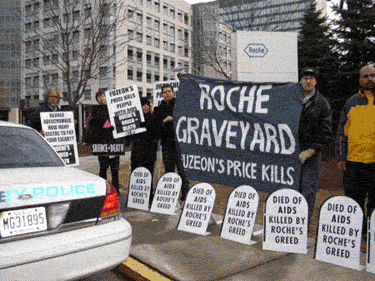
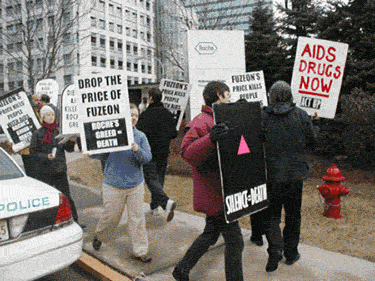
ACT-UP New York PROTESTS FUZEON PRICING
AT ROCHE'S NORTH AMERICAN HEADQUARTERS
(Nutley, NJ 3/13/03)
For complete info see the ACT-UP New York News Release:
ACT
UP CREATES "FUZEON GRAVEYARD" AT
ROCHE HEADQUARTERS